Flux Cored Wire
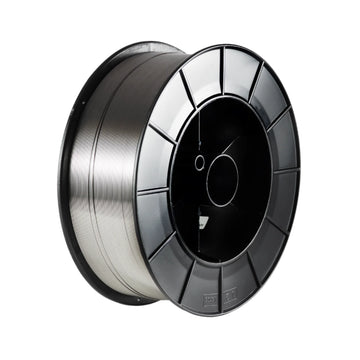
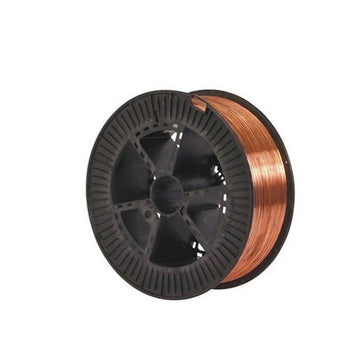
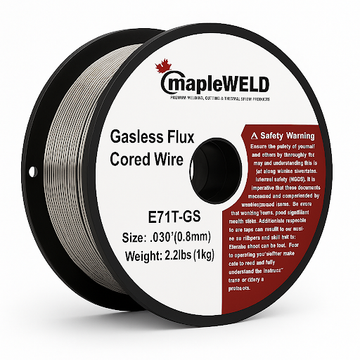
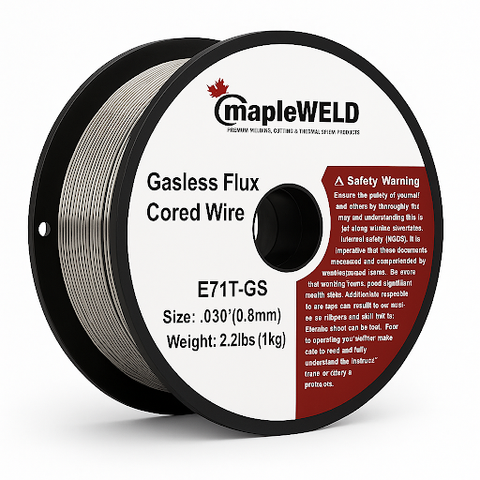
Flux-cored welding wire - E71T-GS self-shielded for outdoor work with no gas bottle, and E71T-1 gas-shielded for multipass structural welding.
Self-shielded or gas-shielded - they behave nothing alike
- E71T-GS is self-shielded, or gasless. The flux core generates its own shielding, so there is no cylinder, no regulator and nothing for wind to strip away. It is a single-pass wire, it runs hot and fast, and it leaves more spatter and slag than anything else here. For fence repair, trailer work, farm equipment and anything outdoors, it is the right tool.
- E71T-1 is gas-shielded and a different proposition entirely - a production wire for multipass structural work, with better mechanical properties, better impact toughness and a smooth spray-like arc. It needs CO2 or a mixed gas and it needs shelter.
Reverse the polarity, or waste your wire
This is the single most common gasless welding failure and it costs people whole spools before they find it.
Solid MIG wire runs DCEP, electrode positive - the way nearly every machine ships from the factory. Self-shielded flux-cored wire runs DCEN, electrode negative. If your gasless welds are spattering violently, piling up on the surface and refusing to fuse, the polarity is wrong. Swap the leads at the machine terminals before you blame the wire.
E71T-1, by contrast, runs DCEP like solid wire. Check the spool label every time you change wire type.
Chip the slag - all of it
Flux-cored wire leaves slag, and slag trapped between passes is a defect that no amount of good technique afterwards repairs. On multipass work, chip and wire-brush every pass before the next one goes down. This is where flux-cored welds fail inspection.
Single pass means single pass
E71T-GS is not rated for multipass structural work. It is tempting on thick material and the result is unpredictable mechanical properties in a joint someone may rely on. For thickness that needs multiple passes and a stated strength, use E71T-1 with gas, or stick.
Keep it dry
Flux absorbs moisture from the air, and moisture in a flux core goes into the weld as hydrogen porosity and cracking. Store spools sealed, keep an opened spool out of an unheated van overnight, and discard wire showing surface rust - the rust is the least of what is wrong with it.
Counter pickup in North York.