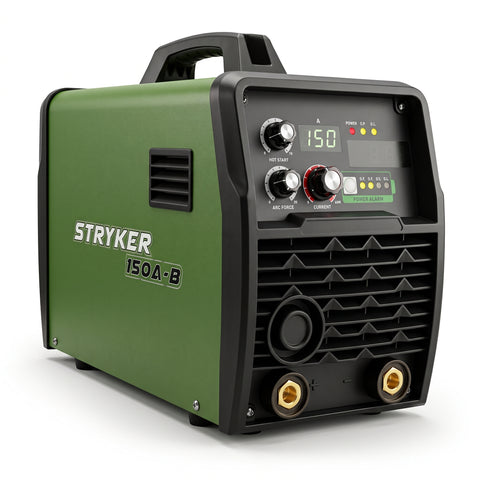
Battery-Powered Welders
Battery-powered welders strike an arc with no generator, no extension cord and no fuel - built for field repairs, rooftops, farm work and anywhere the nearest outlet is too far away.
Where a battery welder earns its cost
These machines replace the generator, not the shop welder. The value is in what they let you avoid: hauling a generator to a roof, running a hundred feet of cord to a fence line, or refusing a job because there is no service on site. They are quiet and produce no exhaust, which makes them workable indoors and in occupied buildings where an engine-driven welder is not an option.
Rods per charge is the specification to compare
Amperage tells you what the machine will run. Rods per charge tells you whether it will finish your job. A unit rated for forty-odd 1/8" electrodes covers a substantial repair; one rated for a dozen covers a tack-up and then needs a charger. Match that figure against a realistic day of your work, then add margin - output tapers as the pack drains.
Recharge time matters as much. A machine that takes several hours to recharge is a one-job-per-day machine unless you carry a second pack.
Stick, and mostly 3/32"
Battery welders run stick. Plan on 3/32" electrodes for the bulk of the work: 1/8" draws current fast and cuts rods per charge sharply. 7018 and 6011 both run well, and 6011 is usually the better field choice on material you cannot clean.
Charge state is the whole machine
Arc quality falls away as the pack depletes, and the weld goes with it. If the arc starts wandering or the rod starts sticking late in a job, that is voltage sag, not technique - stop and charge rather than finishing a structural weld on a flat battery.
Rentals, on-site demonstrations and a walk-in counter in North York. Free shipping over $175 across Canada.