
MIG Welder Birdnesting and Burnback: Causes and Fixes for Drive Rolls, Liners and Tips
Why MIG wire tangles at the drive rolls or welds itself to the contact tip, how to tell which part is causing it, and how to fix it.

In this guide
Quick answer: Birdnesting is when MIG wire tangles at the drive rolls because something further down the gun is stopping it. Burnback is when the wire melts back and welds itself to the contact tip. Both usually come from the same three parts: the drive rolls, the liner and the contact tip. Check them in that order, then check your wire speed, voltage and gun distance.
- Birdnesting
- Wire tangles at the drive rolls. Look for a block or drag further down the gun.
- Burnback
- Wire welds itself to the contact tip. Usually wire speed too slow, or the gun too close.
- Main causes
- Drive rolls, liner or contact tip that is the wrong size, worn, dirty or badly set.
- Fix order
- Start at the machine and work towards the tip.
What is birdnesting?
Birdnesting, also called a bird's nest, happens when the drive rolls keep pushing wire that cannot move forward. The wire buckles and wraps around the drive rolls inside the machine. The tangle shows up at the rolls, but the cause is almost always further down: a blocked contact tip, a liner that drags, or a gap the wire can bend into.
What is burnback?
Burnback happens when the wire melts faster than it feeds. The arc climbs back to the contact tip and welds the wire to it, so you see a small ball of metal on the end of the tip and the wire stops feeding.
Many machines also have a burnback setting. It keeps the wire live for a moment after you release the trigger, so the wire does not stick in the weld. Set too high, it can melt the wire back to the tip.
Swipe sideways to see the whole drawing.
Birdnesting: causes and fixes
| Cause | How to tell | Fix |
|---|---|---|
| Drive roll tension too tight | Wire looks flattened or marked | Loosen it and reset with the test below |
| Wrong drive roll groove | Groove does not match the wire size or type | V-groove for solid wire, knurled for flux-cored, U-groove for aluminum |
| Gap at the drive rolls | Wire bends between the rolls and the gun | Fit the right wire guides and push the gun fully into the machine |
| Liner wrong size | Problem started after a new liner or wire size | Fit a liner made for your wire size |
| Liner cut too short, kinked or dirty | Wire is hard to pull through the gun by hand | Replace the liner and trim it with the cable laid straight |
| Contact tip blocked or too small | Spatter on the tip, or tip size does not match the wire | Fit a new tip that matches your wire size |
| Gun cable coiled or bent | Problem stops when the cable is straight | Keep the cable straight and use the shortest one that does the job |
| Soft wire in a long gun | Aluminum or thin wire through a long cable | Use a spool gun or a push-pull gun |
See What size MIG gun do I need? for cable lengths and guns for soft wire, and shop necks and liners.
Burnback: causes and fixes
| Cause | How to tell | Fix |
|---|---|---|
| Wire speed too slow for the voltage | The arc gets long and the wire melts back as you weld | Raise the wire speed or lower the voltage, starting from your machine's chart |
| Gun held too close | Tip and nozzle run very hot and collect spatter | Keep about 3/8 in. (10 mm) of wire sticking out for solid wire |
| Wire feed stutters | Wire speed changes while you weld | Reset drive roll tension and check the liner |
| Contact tip worn, wrong size or loose | Bore is oval, or the tip turns by hand | Fit a new tip of the right size and tighten it |
| Spatter on the tip | Spatter balls on the end of the tip and nozzle | Clean with MIG pliers, use anti-spatter, replace the tip when needed |
| Poor work clamp connection | Arc is unstable and the clamp gets warm | Clamp on clean, bare metal close to the weld |
| Burnback setting too high | Wire sticks to the tip right after you stop | Turn the setting down towards the middle |
Swipe sideways to see the whole drawing.
Flux-cored wire usually needs more wire sticking out than solid wire, so check the spool label. Shop contact tips and anti-spatter.
How to set drive roll tension
- Check the groove: the groove facing the wire must match your wire size and type.
- Loosen the tension knob until the wire slips at the rolls when you pull the trigger.
- Hold the gun about 1 in. (25 mm) from a block of wood and pull the trigger.
- Tighten half a turn at a time until the wire stops slipping and curls against the wood.
- Stop there, or add no more than another half turn.
| Tension | What happens |
|---|---|
| Too loose | Wire slips, the feed stutters and the wire can burn back |
| Right | Wire feeds smoothly at a steady speed |
| Too tight | Wire gets flattened, the rolls and liner wear, and the wire birdnests if anything blocks it |
Flux-cored wire is a soft tube, so it needs a knurled roll and less tension than solid wire. See the MIG wire size chart for the parts to match to each wire size.
Check the parts in this order
Work from the machine towards the tip, one part at a time, so you find the cause instead of guessing.
- Spool: the hub brake should stop the spool when you release the trigger, without loose loops of wire.
- Drive rolls: right groove, right size, not worn, tension set with the test above.
- Wire guides and gun connection: no gap between the rolls and the gun, and the gun pushed fully in.
- Liner: right size for the wire, clean, cut to the right length and free of kinks.
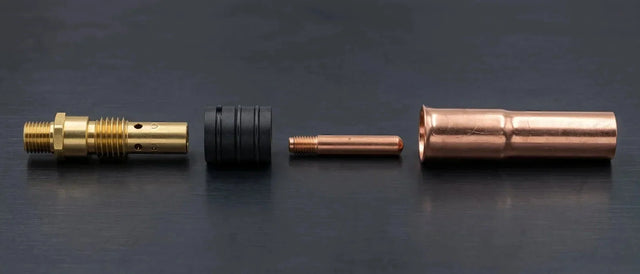
- Contact tip: right size, not worn oval, free of spatter and screwed in tight. See our contact tip and nozzle compatibility guide.
- Settings and technique: wire speed and voltage from the machine's chart, the right gun distance and a clean work clamp connection.
How to prevent birdnesting and burnback
- Replace contact tips before the bore wears oval, and keep a few spares in the right size.
- Clean spatter off the tip and nozzle during breaks.
- Blow out the liner with dry compressed air when you change the wire spool.
- Keep the gun cable straight, without loops, while you weld.
- Store wire in a dry place so it does not rust and drag in the liner.
Safety when you fix a wire feed problem
Turn the machine off before you change the contact tip, liner or drive rolls, or untangle a birdnest.
On most machines the wire is electrically live whenever the trigger is pressed, so keep fingers clear of the drive rolls and point the gun away from yourself and others. The tip and nozzle stay hot after welding, so let them cool or wear welding gloves. Cut wire with pliers and hold the loose end, because it springs. In Canada, CSA W117.2 covers safety in welding, cutting and allied processes. Always follow your machine manual.
Frequently asked questions
Why does my MIG welder keep birdnesting?
The wire is blocked or dragging somewhere between the drive rolls and the contact tip, while the rolls keep pushing. Check the drive roll groove and tension, then the liner, then the contact tip. Too much drive roll tension makes it worse, because the rolls keep forcing wire that cannot move.
Why does my MIG wire keep burning back to the tip?
Usually the wire speed is too slow for the voltage, or the gun is held too close to the work. A feed that stutters, a worn tip or a poor work clamp connection can also cause it. Start from your machine's settings chart and keep about 3/8 in. (10 mm) of solid wire sticking out.
How tight should MIG drive rolls be?
Just tight enough that the wire does not slip. Loosen the tension until the wire slips, then tighten half a turn at a time until it feeds steadily into a block of wood. Add no more than another half turn.
Can the wrong contact tip cause birdnesting?
Yes. A tip that is too small or blocked with spatter stops the wire, so it tangles at the drive rolls. A tip that is too large lets the wire wander, which makes the arc unstable and can cause burnback. Use a tip that matches your wire size.
Can a MIG liner cause birdnesting?
Yes. A liner that is the wrong size, cut too short, kinked or full of dirt makes the wire drag. Fit a liner made for your wire size and trim it to length with the gun cable laid straight.
How do I fix a MIG burnback?
Turn the machine off, cut the wire, remove the contact tip and fit a new one. The bore of a tip with wire welded to it is usually damaged. Then find the cause, such as wire speed, gun distance or feeding, before you weld again.
What does the burnback setting do on a MIG welder?
It keeps the wire live for a moment after you release the trigger, so the end of the wire does not stick in the weld. Too low, and the wire sticks in the weld. Too high, and it can melt the wire back to the tip.
Does flux-cored wire birdnest more easily?
It can, because flux-cored wire is a soft tube that flattens under too much pressure. Use a knurled drive roll in the right size and less tension than you would use for solid wire.
Still getting birdnests or burnbacks?
Email a photo of your drive rolls, contact tip and machine rating plate to orders@mapindpro.com, call 905-919-1177, or visit our Toronto counter. We'll help you find the cause and the right parts.
Gear from this guide
In stock at the Toronto counter. Order online and collect the same day, or have it shipped Canada-wide.

MIG Pliers Complete with Secure Belt Holster
$29.99
MW500 Split Leather Stick/MIG Welding Gloves
$18.99
Red Maple Auto-Darkening Welding Helmet – True Color Auto-Darkening Helmet Shade 5-9/9-13
$129.00
Leather Welding Jacket
$99.00Related guides

How to Replace a MIG Liner: Steel vs PTFE, Measuring and Trimming, Step by Step
Steel or PTFE, how to measure and trim a MIG liner, and how to replace it step by step, with...

MIG Wire Size Chart: .023 vs .030 vs .035 vs .045 by Metal Thickness and Amperage
Choose .023, .030, .035 or .045 MIG wire by the current you weld at and the thickness of your steel,...
MIG Contact Tip and Nozzle Compatibility Guide: Threaded vs Non-Threaded
Contact tips, gas diffusers, insulators and nozzles only work as a matched set. Learn threaded vs non-threaded tips, thread-on vs...