
Plasma Cutting
Plasma cutting torches and the consumable stack that goes inside them. Plasma is unforgiving of worn consumables in a way that welding processes are not: cut quality degrades measurably within minutes of a consumable going out of tolerance.
The consumable stack
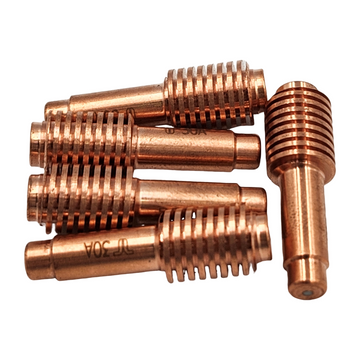
- Electrode - carries the arc. The hafnium insert erodes with every pierce. Depth of the pit is the wear measure, not appearance.
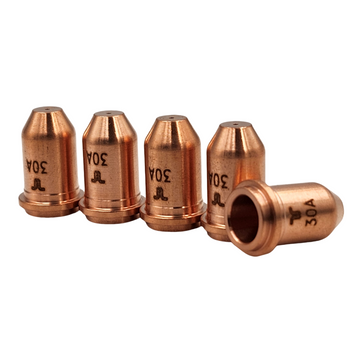
- Nozzle - constricts the plasma jet and sets the cut width. An out-of-round orifice produces a bevelled, dross-heavy cut.
- Swirl ring - spins the gas around the electrode. A blocked port skews the arc and the cut wanders.
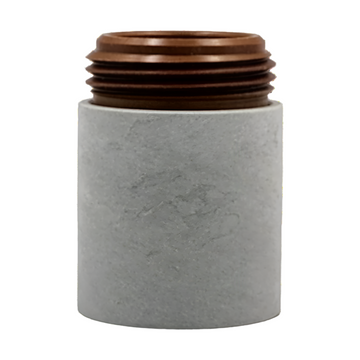
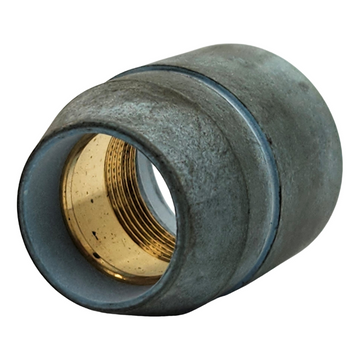
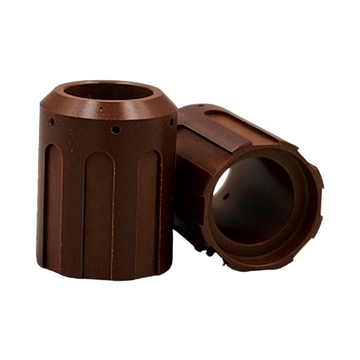
- Shield and retaining cap - protect the stack and set standoff height.
Change them as a set
Electrode and nozzle wear together and should be replaced together. Running a new nozzle against a worn electrode destroys the nozzle quickly, which is a false economy most operators learn once.
Amperage rating is not optional
Consumables are rated for a specific amperage. Running a 45A nozzle at 65A shortens its life dramatically and widens the kerf. Match the stack to the current you actually cut at.
Air quality drives consumable life
Moisture and oil in the supply air are the fastest way to destroy plasma consumables. If cut quality dropped suddenly and the stack is new, check the air dryer and filter before anything else.
Browse plasma parts by type: electrodes, nozzles, retaining caps, shields, swirl rings, torches, PT-32 valve pins, gouging, Hypertherm and Dynaflux water table treatment.
Counter pickup in North York, where we can match a stack against the torch you bring in.

220892 Plasma Nozzles 130A (Pack of 5) – HyPro 2000/HT2000 Replacement
$79.00
220670 Plasma Swirl Ring 45A – Powermax 45 T30v/T45v/T45m Replacement
$39.00
220857 Plasma Swirl Ring 45-85A – Powermax 65/85/105 DURAMAX Replacement
$29.90
220777 Plasma Electrodes 45-105A (Pack of 5) – DURAMAX Replacement
$129.00
220340 Plasma Cooling Tube 30-260A – HPR130/260/400XD Replacement
$39.00
220051 Plasma Swirl Ring (2-Pack) – Powermax 1000/1250/1650 Replacement
$58.70
220011 Plasma Nozzle 100A (5-Pack) – Powermax 1000/1250/1650 Replacement
$74.95
Plasma Cutter Troubleshooting: Bad Cuts, Dross, and Lost Arc
Quick answer: Almost every plasma cutting problem — can’t cut through, dross-covered edges, a lost arc, or fast-wearing consumables — comes down to one of four...